
What does a small business website cost in NZ?
What you pay for, what you shouldn't, and the questions to ask before you sign anything.
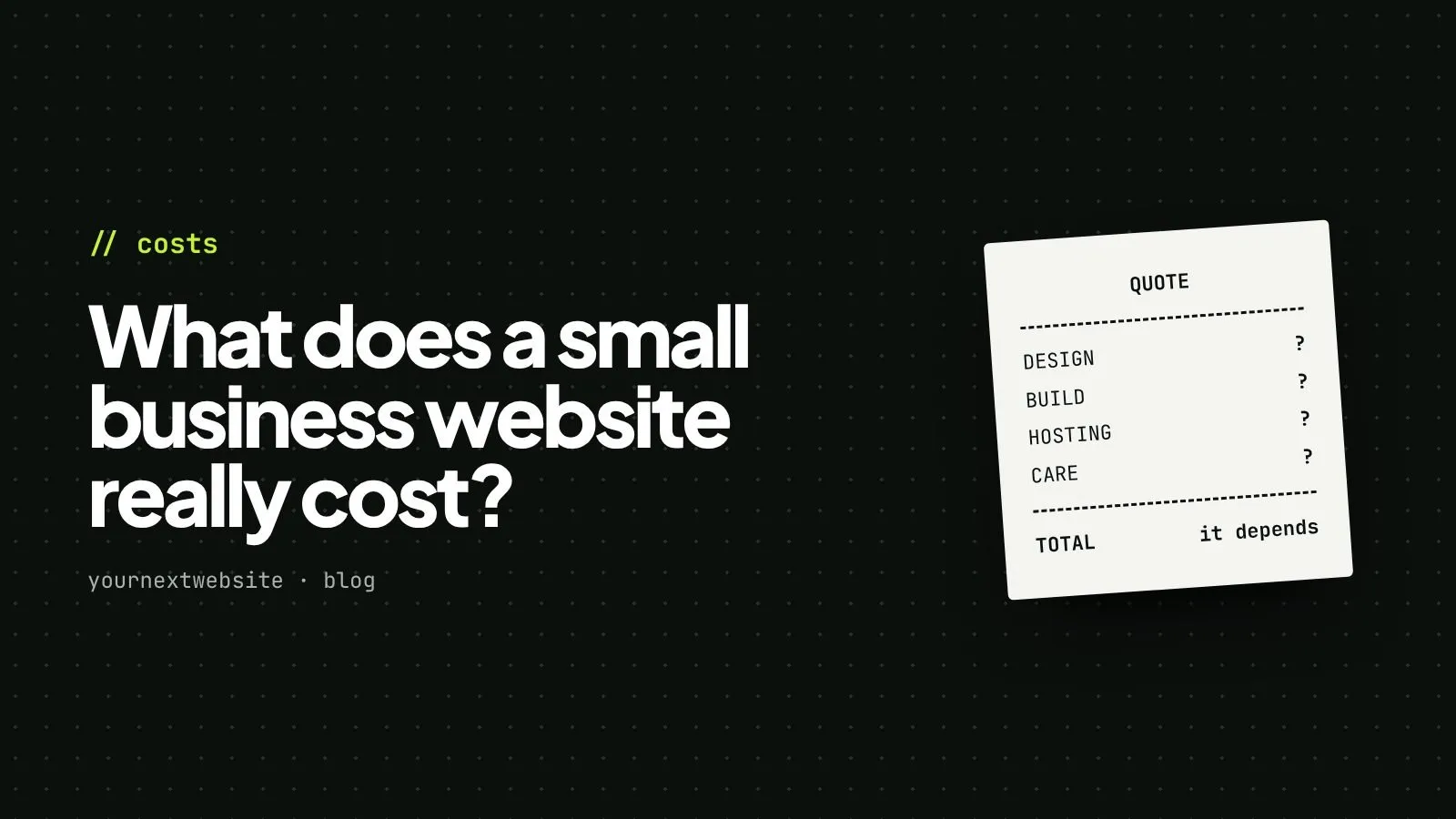
Most people ask me about price before anything else, and it’s a fair question. The trouble is that “a website” covers everything from a one-page site you build yourself on a Sunday afternoon to a shop with hundreds of products, online bookings and staff logins. Asking what a website costs is a bit like asking what a vehicle costs. A ute and a hatchback both get you to work.
So instead of throwing numbers around, this post walks through what actually goes into the price, what keeps costing you after launch, and the questions that will tell you whether a quote is fair.
The three ways to get a website
Build it yourself. Website builders like Wix, Squarespace and Shopify let you pick a template and fill it in. You pay a monthly or yearly subscription, and you do the work. This suits some businesses well, especially if you enjoy that sort of thing and your needs are simple. The hidden cost is your time, and the fact that you’re responsible for how well it works on phones, how fast it loads and how Google sees it.
Pay someone to set up a template. A freelancer or agency takes an off-the-shelf theme and adds your logo, words and photos. It’s quicker and cheaper than custom work. The catch is that you get the template’s limits, its extra code and often a pile of plugins that need ongoing updates.
Have it designed and built for your business. Someone works out what your customers need to see and do, designs around that, and builds it properly from the start. It costs more up front than a template, but you’re paying for a site that fits your business instead of a business squeezed into a template.
None of these is wrong. The right one depends on how much the website matters to your income and how much time you want to spend on it.
What you’re paying for
When you get a quote, the price is usually made up of these parts.
Planning and design. Working out what pages you need, what goes on them and what you want visitors to do: call, book, buy or send an enquiry. This is the part that makes the biggest difference to how many enquiries a site brings in, and it’s the part cheap options skip.
The build. Turning the design into a working site that loads fast on a phone, works for people using screen readers, and is set up so Google can understand it. You won’t see most of this work, but it shows up in your results.
Words and photos. If you supply your own text and photos, the job is smaller. If you want help writing pages or finding good photos, that’s extra time. Good words matter more than most people think. A clear headline that says what you do and where you do it beats a clever one every time.
Features. A contact form is simple. An online shop, booking system, blog or customer login each add work, and some add ongoing costs. A useful test: will you actually use it in the first year? If not, leave it out and add it later.
Moving from an old site. If you already have a website that Google knows about, the old page addresses need to point to the new ones. Skip this and you can lose search rankings you’ve built up over years.
The costs that keep going
The build is a one-off. These aren’t, so ask about them before you sign.
- Your domain name. Your .nz or .co.nz address renews every year through a domain registrar. Make sure it’s registered in your business’s name, not your web designer’s.
- Hosting. Somewhere for the site to live. Sometimes it’s bundled into a monthly plan, sometimes it’s separate.
- Care and updates. Security fixes, software updates, backups and keeping an eye on whether the site is up. Some sites need a lot of this (anything with lots of plugins), some need very little.
- Changes. New photos, new prices, a new page. Find out whether you can do these yourself or whether each one is a paid job.
- Email. Business email on your own domain (like you@yourbusiness.co.nz) is often a separate subscription, usually charged per person.
- GST. If the quote says “+GST”, add 15% to compare it fairly with one that includes GST.
What you shouldn’t be paying for
Surprises. A fair quote lists what’s included. If you ask for something that isn’t on it, you should know the cost before the work starts, not when the invoice arrives.
A site you don’t own. Your domain should be in your name and your words and photos are yours. If the person who built your site disappeared tomorrow, you should still be able to take everything elsewhere.
Lock-in. Long contracts that are expensive to leave protect the seller. A good web designer keeps clients because the work is good, not because leaving is hard.
Things you don’t need. Ten pages when four would do. A blog you’ll never post to. A booking system for a business that takes three bookings a month by phone.
Seven questions to ask before you sign
- What exactly is included: pages, features, rounds of changes, and who writes the words?
- Is the price fixed, and what happens if I ask for something extra partway through?
- What will this cost me each year after it’s live?
- Who owns the domain name and the content?
- Can I make small changes myself, and how do bigger changes work?
- How fast will it load on a phone? Will you show me a Google Lighthouse or PageSpeed report?
- If I want to move to someone else later, what do I get to take with me?
A good web designer will answer all of these without squirming. If you get vague answers, that tells you something too.
So, cheap or expensive?
The cheapest option often costs more in the long run: a slow site that doesn’t show up on Google, or one you have to rebuild in two years. The most expensive option isn’t automatically better either. Aim for the site that brings you customers, that you can afford to run, and that you could walk away with if you ever needed to.
How I price websites
I don’t publish a price list, because no two businesses need quite the same thing. Tell me what you need and you’ll get a fixed quote within one working day. It lists what’s included, shows the ongoing costs, and you own the site whatever you decide.
Start a project or have a look at the common questions first.